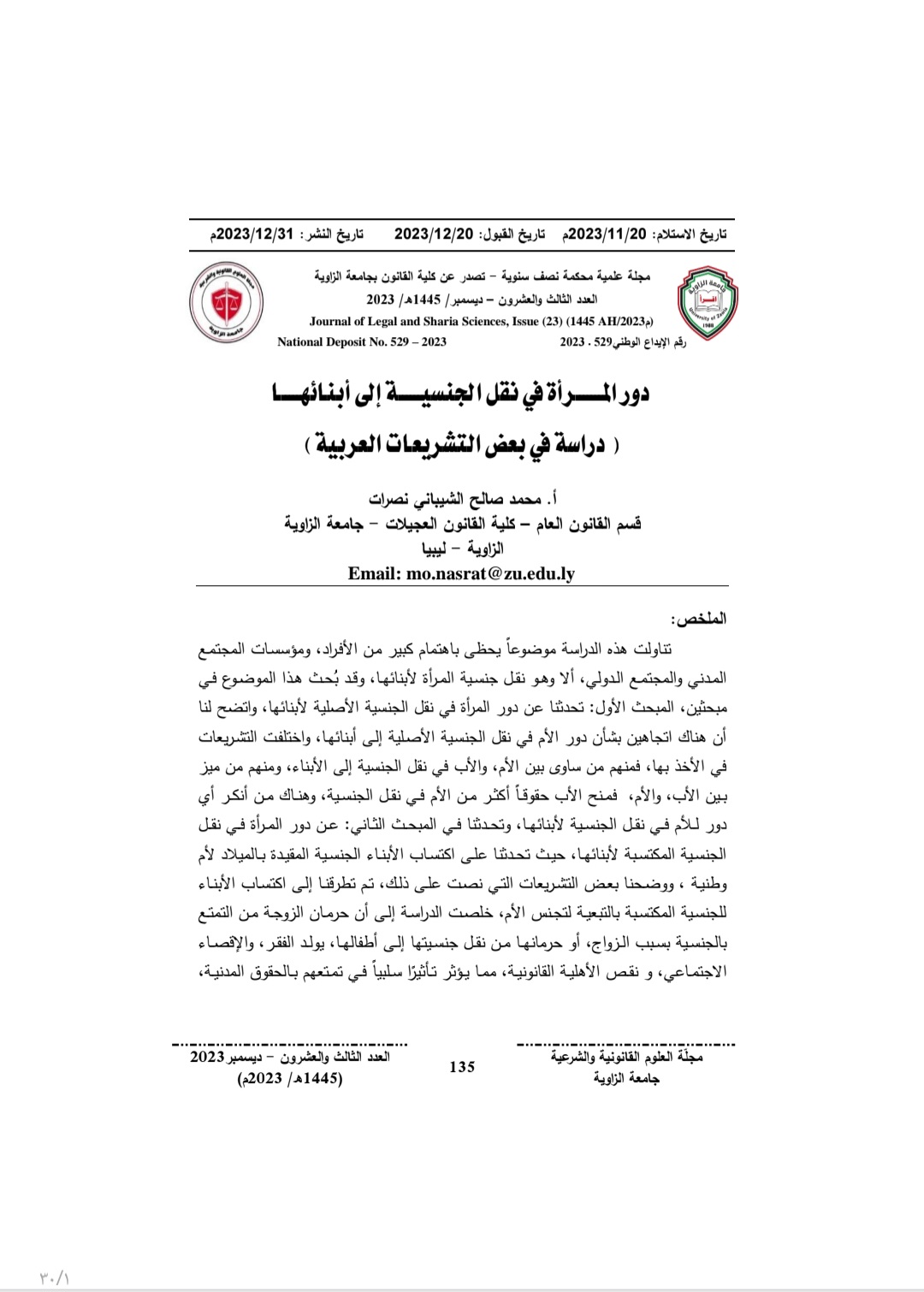
The role of women in transmitting nationality to their children (A study of some Arab legislation)
Abstract
This study dealt with a topic of great interest to individuals, civil society institutions, and the international community, which is transferring a woman's nationality to her children. This topic was discussed in two sections. In the first section, we talked about the role of women in transferring the original nationality to their children, and it became clear to us that there are two trends regarding the role of the mother. In transferring the original nationality to her children, legislation differed in adopting it. Some of them equated the mother and father in transmitting nationality to the children, and some of them distinguished between the father and the mother, granting the father more rights than the mother in transferring nationality. There are those who denied any role for the mother in transferring nationality to her children. In the second section, we talked about the role of women in transmitting acquired nationality to their children, where we talked about children acquiring acquired nationality restricted by birth to a national mother, and we explained some of the legislation that stipulates that. We touched on children acquiring acquired nationality as a result of the mother's nationality. The study concluded that depriving Preventing a wife from enjoying nationality due to marriage, or depriving her of transmitting her nationality to her children, generates poverty, social exclusion, and lack of legal capacity, which negatively affects their enjoyment of relevant civil, political, economic, social, and cultural rights, especially in the areas of education, housing, work, health, and social security.







 | Articles published in the Univ Zawia J Legal Sharia Sci are licensed under a