Boswellia serrata Resin Mitigates Doxorubicin-Induced Cardiac Oxidative Stress, Biomarker Leakage, and Myocardial Histopathological Injury in Rats
Article Sidebar
Main Article Content
Abstract
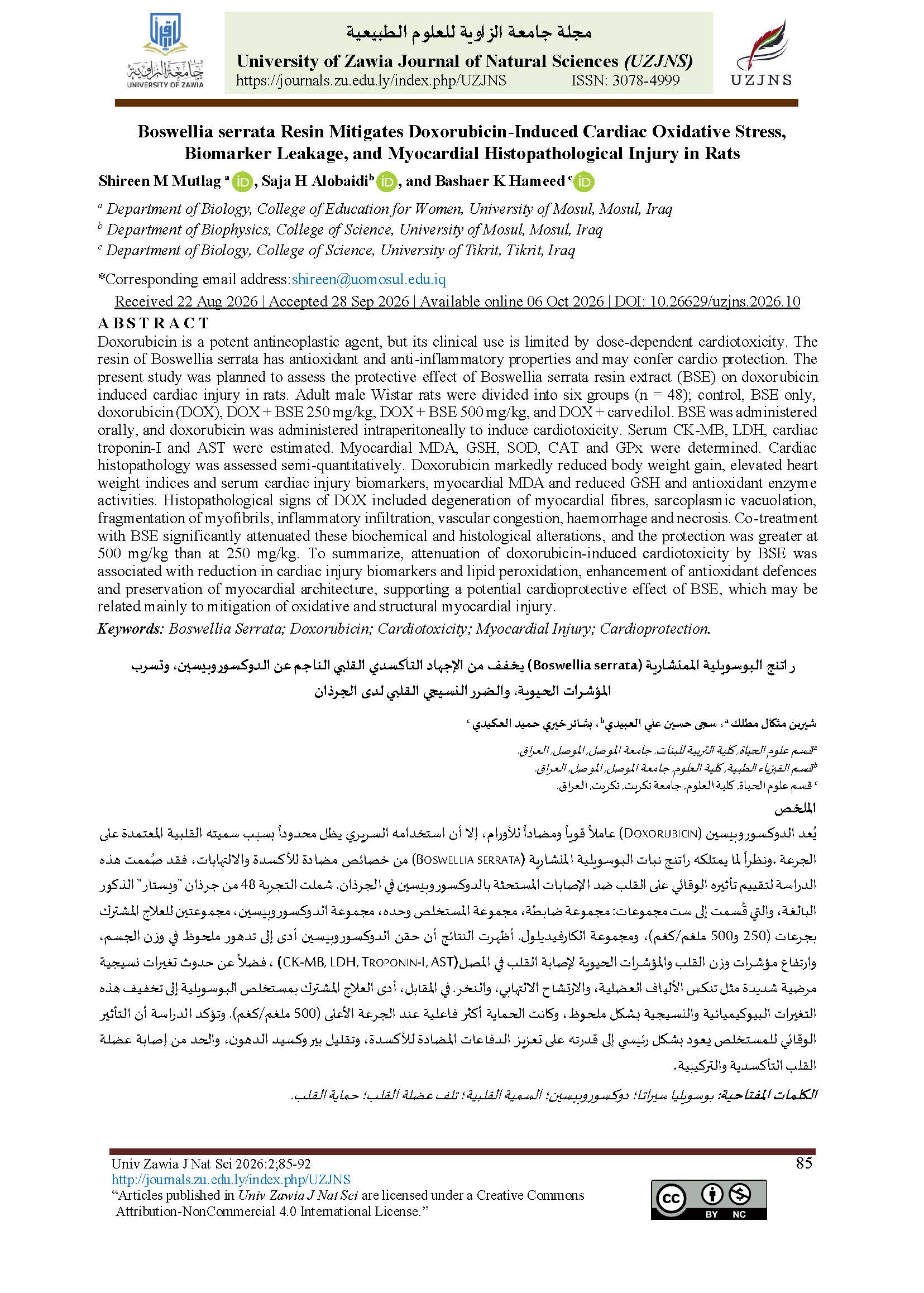
Doxorubicin is a potent antineoplastic agent, but its clinical use is limited by dose-dependent cardiotoxicity. The resin of Boswellia serrata has antioxidant and anti-inflammatory properties and may confer cardio protection. The present study was planned to assess the protective effect of Boswellia serrata resin extract (BSE) on doxorubicin induced cardiac injury in rats. Adult male Wistar rats were divided into six groups (n = 48); control, BSE only, doxorubicin (DOX), DOX + BSE 250 mg/kg, DOX + BSE 500 mg/kg, and DOX + carvedilol. BSE was administered orally, and doxorubicin was administered intraperitoneally to induce cardiotoxicity. Serum CK-MB, LDH, cardiac troponin-I and AST were estimated. Myocardial MDA, GSH, SOD, CAT and GPx were determined. Cardiac histopathology was assessed semi-quantitatively. Doxorubicin markedly reduced body weight gain, elevated heart weight indices and serum cardiac injury biomarkers, myocardial MDA and reduced GSH and antioxidant enzyme activities. Histopathological signs of DOX included degeneration of myocardial fibres, sarcoplasmic vacuolation, fragmentation of myofibrils, inflammatory infiltration, vascular congestion, haemorrhage and necrosis. Co-treatment with BSE significantly attenuated these biochemical and histological alterations, and the protection was greater at 500 mg/kg than at 250 mg/kg. To summarize, attenuation of doxorubicin-induced cardiotoxicity by BSE was associated with reduction in cardiac injury biomarkers and lipid peroxidation, enhancement of antioxidant defences and preservation of myocardial architecture, supporting a potential cardioprotective effect of BSE, which may be related mainly to mitigation of oxidative and structural myocardial injury.
Article Details

This work is licensed under a Creative Commons Attribution-NonCommercial 4.0 International License.
This work is licensed under a Creative Commons Attribution-NonCommercial 4.0 International License.
You are free to:
- Share — copy and redistribute the material in any medium or format.
- Adapt — remix, transform, and build upon the material.
Under the following terms:
- Attribution — You must give appropriate credit, provide a link to the license, and indicate if changes were made. You may do so in any reasonable manner, but not in any way that suggests the licensor endorses you or your use.
- NonCommercial — You may not use the material for commercial purposes.
- No additional restrictions — You may not apply legal terms or technological measures that legally restrict others from doing anything the license permits.
References
[1] V. Bhutani, F. Varzideh, S. Wilson, U. Kansakar, S. S. Jankauskas, and G. Santulli, “Doxorubicin-induced cardiotoxicity: A comprehensive update,” J. Cardiovasc. Dev. Dis., vol. 12, no. 6, Art. no. 207, 2025, doi: 10.3390/jcdd12060207.
[2] R. Vitale, S. Marzocco, and A. Popolo, “Role of oxidative stress and inflammation in doxorubicin-induced cardiotoxicity: A brief account,” Int. J. Mol. Sci., vol. 25, no. 13, Art. no. 7477, 2024, doi: 10.3390/ijms25137477.
[3] J. Wang et al., “Molecular mechanisms of doxorubicin-induced cardiotoxicity: Novel roles of sirtuin 1-mediated signaling pathways,” Cell. Mol. Life Sci., vol. 78, no. 7, pp. 3105–3125, 2021, doi: 10.1007/s00018-020-03729-y.
[4] A. N. Linders, I. B. Dias, T. López Fernández, C. G. Tocchetti, N. Bomer, and P. van der Meer, “A review of the pathophysiological mechanisms of doxorubicin-induced cardiotoxicity and aging,” npj Aging, vol. 10, Art. no. 9, 2024, doi: 10.1038/s41514-024-00135-7.
[5] M. Z. Siddiqui, “Boswellia serrata, a potential antiinflammatory agent: An overview,” Indian J. Pharm. Sci., vol. 73, no. 3, pp. 255–261, 2011, doi: 10.4103/0250-474X.93507.
[6] F. Börner, M. Werner, J. Ertelt, J. Meins, M. Abdel-Tawab, and O. Werz, “Analysis of boswellic acid contents and related pharmacological activities of frankincense-based remedies that modulate inflammation,” Pharmaceuticals, vol. 14, no. 7, Art. no. 660, 2021, doi: 10.3390/ph14070660.
[7] C. Peng, Y. Yang, Y. Wang, B. Gong, X. Sun, and X. Yang, “From bench to bedside, boswellic acids in anti-inflammatory therapy—Mechanistic insights, bioavailability challenges, and optimization approaches,” Front. Pharmacol., vol. 16, Art. no. 1692443, 2025, doi: 10.3389/fphar.2025.1692443.
[8] S. A. Ali, S. A. Zaitone, and Y. M. Moustafa, “Boswellic acids synergize antitumor activity and protect against the cardiotoxicity of doxorubicin in mice bearing Ehrlich’s carcinoma,” Can. J. Physiol. Pharmacol., vol. 93, no. 8, pp. 695–708, 2015, doi: 10.1139/cjpp-2014-0524.
[9] M. H. Shahid, I. Anjum, M. N. Mushtaq, and S. Riaz, “Cardioprotective effect of boswellic acids against doxorubicin-induced myocardial infarction in rats,” Pak. J. Pharm. Sci., vol. 34, no. 1, suppl., pp. 359–365, 2021, doi: 10.36721/PJPS.2021.34.1.SUP.359-365.1.
[10] M. Javdani, M. Ahmadi-Dastjerdi, and S. Shirian, “Effect of Boswellia serrata extract on tissue inflammation and white blood cells responses of spinal cord injury in rat model,” J. Herbmed Pharmacol., vol. 7, no. 4, pp. 273–279, 2018, doi: 10.15171/jhp.2018.41.
[11] A. M. Alanazi, L. Fadda, A. Alhusaini, R. Ahmad, I. H. Hasan, and A. M. Mahmoud, “Liposomal resveratrol and/or carvedilol attenuate doxorubicin-induced cardiotoxicity by modulating inflammation, oxidative stress and S100A1 in rats,” Antioxidants, vol. 9, no. 2, Art. no. 159, 2020, doi: 10.3390/antiox9020159.
[12] A. Z. Ahmed, S. M. Satyam, P. Shetty, and M. R. D’Souza, “Methyl gallate attenuates doxorubicin-induced cardiotoxicity in rats by suppressing oxidative stress,” Scientifica, vol. 2021, Art. no. 6694340, 2021, doi: 10.1155/2021/6694340.
[13] A. Z. Ahmed, K. D. Mumbrekar, S. M. Satyam, P. Shetty, and M. R. D’Souza, “Chia seed oil ameliorates doxorubicin-induced cardiotoxicity in female Wistar rats: An electrocardiographic, biochemical and histopathological approach,” Cardiovasc. Toxicol., vol. 21, no. 7, pp. 533–542, 2021, doi: 10.1007/s12012-021-09644-3.
[14] L. Zhang, Q. Jiang, X. Wang, A. Jaisi, and O. J. Olatunji, “Boesenbergia rotunda displayed anti-inflammatory, antioxidant and anti-apoptotic efficacy in doxorubicin-induced cardiotoxicity in rats,” Sci. Rep., vol. 13, Art. no. 11398, 2023, doi: 10.1038/s41598-023-38560-5.