
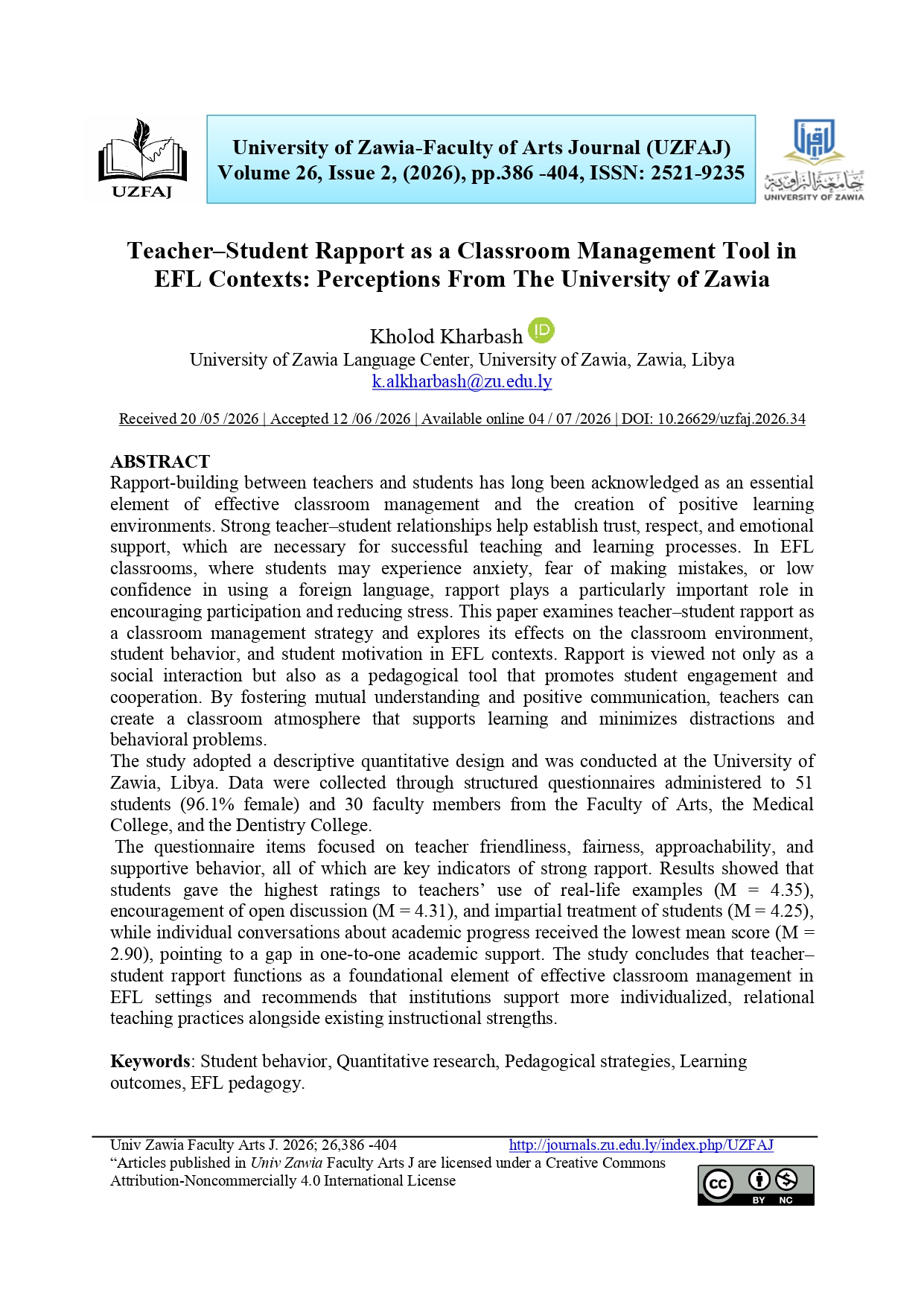
العلاقة بين المعلم والطالب كأداة لإدارة الصف الدراسي في سياقات تعليم اللغة الإنجليزية كلغة أجنبية تصورات من جامعة الزاوية
DOI:
https://doi.org/10.26629/uzfaj.2026.34الكلمات المفتاحية:
سلوك الطلاب، البحث الكمي، الاستراتيجيات التربوية، مخرجات التعليم، تدريس اللغة الانجليزية كلغة اجنبية.الملخص
تُعد العلاقة الإيجابية (Rapport) بين المعلم والطالب عنصرًا أساسيًا في الإدارة الفعالة للفصل الدراسي وفي تهيئة بيئة تعليمية إيجابية. تتناول هذه الورقة البحثية العلاقة بين المعلم والطالب بوصفها أداة لإدارة الفصل في سياقات تعليم اللغة الإنجليزية كلغة أجنبية، وتستكشف أثرها على بيئة الفصل وسلوك الطلاب ودافعيتهم. اعتمدت الدراسة منهجًا وصفيًا كميًا، وأُجريت في جامعة الزاوية بليبيا، حيث جُمعت البيانات باستخدام استبيانات وُزِّعت على 51 طالبًا (96.1% منهم إناث) و30 عضو هيئة تدريس من كلية الآداب وكلية الطب وكلية طب الأسنان. أظهرت النتائج أن الطلاب أعطوا أعلى التقييمات لاستخدام المعلم أمثلة من الحياة اليومية (م = 4.35)، وتشجيعه للنقاش المفتوح (م = 4.31)، وحياده في معاملة الطلاب (م = 4.25)، في حين سجلت المحادثات الفردية حول التقدم الدراسي أدنى درجة (م = 2.90)، وهو ما يشير إلى وجود فجوة في الدعم الأكاديمي الفردي. وتخلص الدراسة إلى أن العلاقة بين المعلم والطالب تمثل ركيزة أساسية للإدارة الفعالة للفصل في سياقات تعليم اللغة الإنجليزية كلغة أجنبية، وتوصي بتعزيز الممارسات التعليمية الفردية والعلائقية إلى جانب نقاط القوة التدريسية القائمة.
المراجع
-Barkhuizen, G. (2020). Narrative inquiry in language teaching and learning. Routledge.
-Creswell, J. W., & Creswell, J. D. (2022). [Full title, edition, and publisher to be confirmed by the author — cited in Section 3.2, Instruments of Data Collection.]
-Dewaele, J. M., & MacIntyre, P. D. (2020). The emotional rollercoaster of foreign language learning: Enjoyment, anxiety, and motivation. The Modern Language Journal, 104(4), 847–863.
Waragh , I. (2026). Empowering Libyan University Students Through Presentation Skills: A Key to Student-centered .Educational Process. University of Zawia -Faculty of Arts Journal, 26(1), 84–95. https://doi.org/10.26629/uzfaj.2026.05 .
-Dörnyei, Z., & Dewaele, J.-M. (2023). [Full title, edition, and publisher to be confirmed by the author — cited in Section 3.2, Instruments of Data Collection.]
-Frisby, B. N., & Martin, M. M. (2021). Instructor–student rapport and motivation: The role of verbal immediacy. Communication Education, 70(1), 1–17.
-Krashen, S. D. (1982). Principles and practice in second language acquisition. Pergamon Press.
-Mai ([2024]). [Title, journal/publisher, volume, and pages to be confirmed by the author — cited in Section 5.0, Discussion.]
-Oga-Baldwin, W. L. Q., Nakata, Y., Parker, P., & Ryan, R. M. (2020). - - Motivation and engagement in language learning: A self-determination theory perspective. System, 89, 102115.
-Titsworth, S., Mazer, J. P., Goodboy, A. K., Bolkan, S., & Myers, S. A. (2020). Teacher immediacy and classroom outcomes. Communication Education, 69(2), 167–187.
-Xie, F., & Derakhshan, A. (2021). A conceptual review of positive teacher–student relationships in EFL classrooms. Frontiers in Psychology, 12, 1–9.
-Zhang ([2023]). [Title, journal/publisher, volume, and pages to be confirmed by the author — cited in Section 5.0, Discussion.]
-Zhou ([2026]). [Title, journal/publisher, volume, and pages to be confirmed by the author — cited in Section 5.0, Discussion.]
Albosaifi, S. (2023). Grammatical Problems Encountered by English Language University Students in Writing. University of Zawia -Faculty of Arts Journal, (23)(40), 52–62. https://doi.org/10.26629 uzfaj.v23i(40)
التنزيلات
منشور
كيفية الاقتباس
إصدار
القسم
الرخصة
الحقوق الفكرية (c) 2026 جامعة الزاوية - مجلة كلية الآداب

هذا العمل مرخص بموجب Creative Commons Attribution-NonCommercial 4.0 International License.







 International License.