
استكشاف استراتيجيات طرح الأسئلة لدى المعلم في صفوف اللغة الإنجليزية كلغة أجنبية: دراسة حالة في جامعة الزاوية
DOI:
https://doi.org/10.26629/uzfaj.2026.01الملخص
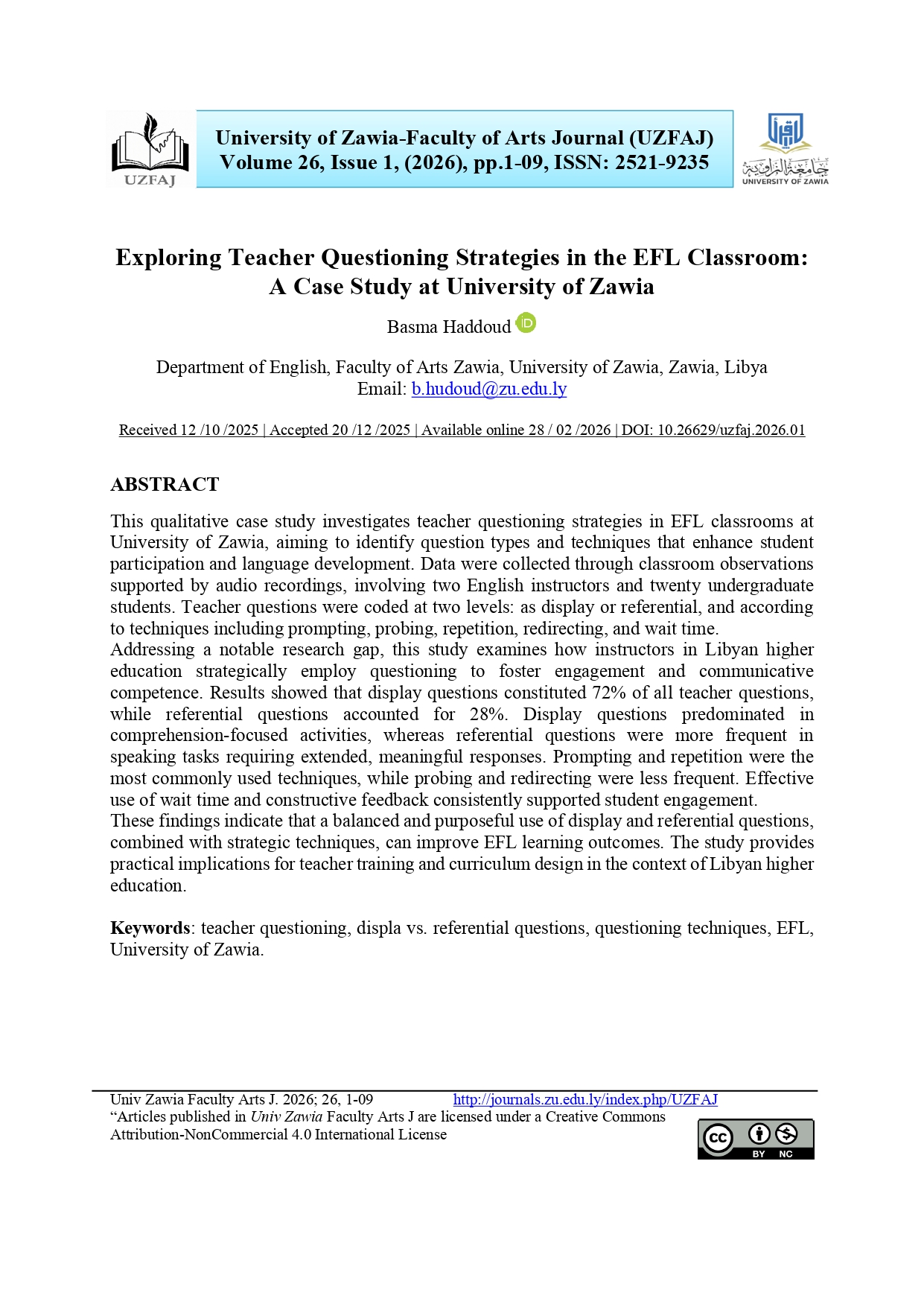
تمحورت هذه الدراسة النوعية حول استراتيجيات طرح الأسئلة لدى معلمي اللغة الإنجليزية كلغة أجنبية في جامعة الزاوية، بهدف التعرف إلى أنواع الأسئلة والتقنيات التي تعزز مشاركة الطلبة وتنمي مهاراتهم اللغوية. جُمعت البيانات من خلال ملاحظات صفية مدعومة بتسجيلات صوتية، بمشاركة معلمين اثنين وعشرين طالباً جامعياً. صُنفت أسئلة المعلمين إلى أسئلة عرضية وأخرى استقصائية، كما حُللت التقنيات المصاحبة لها مثل التحفيز، والاستقصاء، والتكرار، وإعادة التوجيه، ووقت الانتظار. فكشفت النتائج أن الأسئلة العرضية استحوذت على 72% من إجمالي الأسئلة، مقابل 28% للأسئلة الاستقصائية. وبرز استخدام الأسئلة العرضية في أنشطة الفهم، بينما ظهرت الأسئلة الاستقصائية بصورة أكبر في الأنشطة الشفوية التي تتطلب إجابات موسعة وذات معنى. كما تبين أن تقنيتي التحفيز والتكرار كانتا الأكثر توظيفاً، في حين كان استخدام الاستقصاء وإعادة التوجيه أقل شيوعاً. وأسهم توظيف وقت الانتظار والتغذية الراجعة البناءة في تعزيز تفاعل الطلبة واستمراريته. وتؤكد الدراسة أن الاستخدام المتوازن والمقصود لأنماط الأسئلة وتقنياتها يمكن أن يحسن نتائج تعلم اللغة الإنجليزية، وتقدم دلالات تطبيقية مهمة لتدريب المعلمين وتطوير المناهج .
المراجع
Abulhul, S. (2021). Strategies for enhancing students’ learning processes and outcomes. Journal of Educational Strategies, 45(3), 145–159.
Basma Hadoud. (2025) Questioning Levels and Techniques in EFL Classrooms,25(2)36- 45 https://doi.org/10.26629/uzfaj2025.03
Anderson, L. W., & Krathwohl, D. R. (Eds.). (2001). *A taxonomy for learning, teaching, and assessing: A revision of Bloom’s taxonomy of educational objectives*. Longman.
Atan Long, M. (1980). The importance of equitable distribution in classroom questioning. Journal of Educational Dynamics, 12(4), 45–53.
Braun, V., & Clarke, V. (2006). Using thematic analysis in psychology. Qualitative Research in Psychology, 3(2), 77-101.
Brock, C. A. 1986. The effects of referential questions on ESL classroom
discourse. TESOL Quarterly 20-1: 47-59.
Bruner, J. S. (1961). The act of discovery. Harvard Educational Review, 31, 21-32.
Chaudron, C. (2012). The role of educator questions in language classrooms. In Inan & Fidan (Eds.), Prasetyawati’s Education Frameworks (pp. 122–145).
Chin, C. (2004). The impact of teacher questioning on student cognitive engagement. Educational Psychology Review, 16(4), 325–341.
Chin, C. (2007). Exploring students’ understanding through teacher questioning strategies. Science Education International, 18(2), 111–123.
Durkin, D. (1979). Teacher questioning techniques in the classroom. Reading Research Quarterly, 14(4), 481–533.
Eble, K. E. (1988). Effective questioning strategies in teaching and learning. Journal of University Teaching Strategies, 23(3), 78–95.
Eggen, P., & Kauchak, D. (2006). Strategies for teachers: Teaching content and thinking skills (6th ed.). Pearson.
Erianti, R. (2017). An analysis of educators’ questioning strategy in ELT. Journal of Educational Language Teaching Review, 8(1), 45–60.
Erlinda, R. (2014). Types of teacher questions and students’ responses in English classes at SMA Negeri 1 Terbanggi Besar in 2013/2014 academic year (Undergraduate thesis). Lampung University.
Fries Gather, J. (2008). The significance of questioning strategies in teaching and learning. Journal of Educational Inquiry, 19(3), 214–230.
Guest, G. (1985). Questioning strategies and their impact on student learning.
Harvey, S. (2000). Effective teacher questioning: Strategies and practices. In Sujariati (Ed.), Journal of Language Pedagogy (pp. 123–145).
Inan, M., & Fidan, H. (2015). Enhancing classroom interaction through teacher questioning. In Prasetyawati (Ed.), Engaging Learners through Dialogue (pp. 78–79).
Lantolf, J. P. (2004). Sociocultural Theory and Second Language Acquisition. In R. B. Kaplan (ed.)., The Oxford Handbook of Applied Linguistics, pp. 104-114. OUP.
Long, M. H., & Sato, C. J. (1983). Classroom foreigner talk discourse: Forms and functions of teachers’ questions. In H. W. Seliger & M. H. Long (Eds.), Classroom-Oriented Research in Second Language Acquisition (pp. 268–286). Newbury House. -Nunan, D. (2015). Communicative language teaching: Making it work. ELT Journal, 41, 136-145.
Narwasti, A. (2015). Simple and effective questioning in EFL classrooms. Journal of Language Pedagogy, 22(1), 33–48.
Pressley, M., et al. (1998). Teacher questioning practices: A comprehensive review. Educational Research Review, 10(4), 345–366.
Piaget, J. (1970). The Psychology of Intelligence. New York: Basic Books.
Rahman, M., & Mahmud, A. (2016). The role of questioning in language teaching. Journal of Modern Education, 9(3), 167–189.-Richards, J. C., & Lockhart, C. (2011). Exploring teacher–student interaction through questioning. In Kurniawan (Ed.), Teaching Strategies (pp. 33–56).
Rowe, M. B. (1986). Wait time: Slowing down may be a way of speeding up. Journal of Teacher Education, 37(1), 43–50.
Shomoossi, N. (2004). Functions of teacher questioning in language classrooms. Asian EFL Journal, 6(2), 114–131.
Sujariati, M., et al. (2016). Exploring questioning strategies in EFL classrooms. International Journal of Language Pedagogy, 18(2), 56–78.
Sun, Z. (2012). Educators as guides in the learning process. Journal of Educational Horizons, 29(3), 89–102.
Tamas, A., & Wang, J. (2017). Promoting higher-order thinking through teacher questioning. Journal of Critical Thinking in Education, 11(4), 203–218.
Vygotsky, L. S. (1978). Mind in society. Cole, M., Jolm-Steiner, V., Scribner, S., & Souberman, E. (Eds) Harvard University Press https://doi.org/10.2307/j.ctvjf9vz4
Wangru, C. (2016). Probing and promoting through questioning: A teacher’s guide. Journal of Modern Language Teaching, 19(1), 134–152.
Walsh, J. A., & Sattes, B. D. (2011). Thinking through quality questioning: Deepening student engagement. Corwin Press.
Yang, J. (2010). Teacher questioning in second language classrooms: Effects of questioning techniques on classroom interaction. Procedia – Social and Behavioral Sciences, 2(2), 4187–4193.
التنزيلات
منشور
كيفية الاقتباس
إصدار
القسم
الرخصة
الحقوق الفكرية (c) 2026 جامعة الزاوية - مجلة كلية الآداب

هذا العمل مرخص بموجب Creative Commons Attribution-NonCommercial 4.0 International License.







 International License.