
Techno-Economic Assessment of Solar-Powered Iron Production Plant Based on Wadi Al-Shati Iron Ore in Libya
Article Sidebar
Main Article Content
Abstract
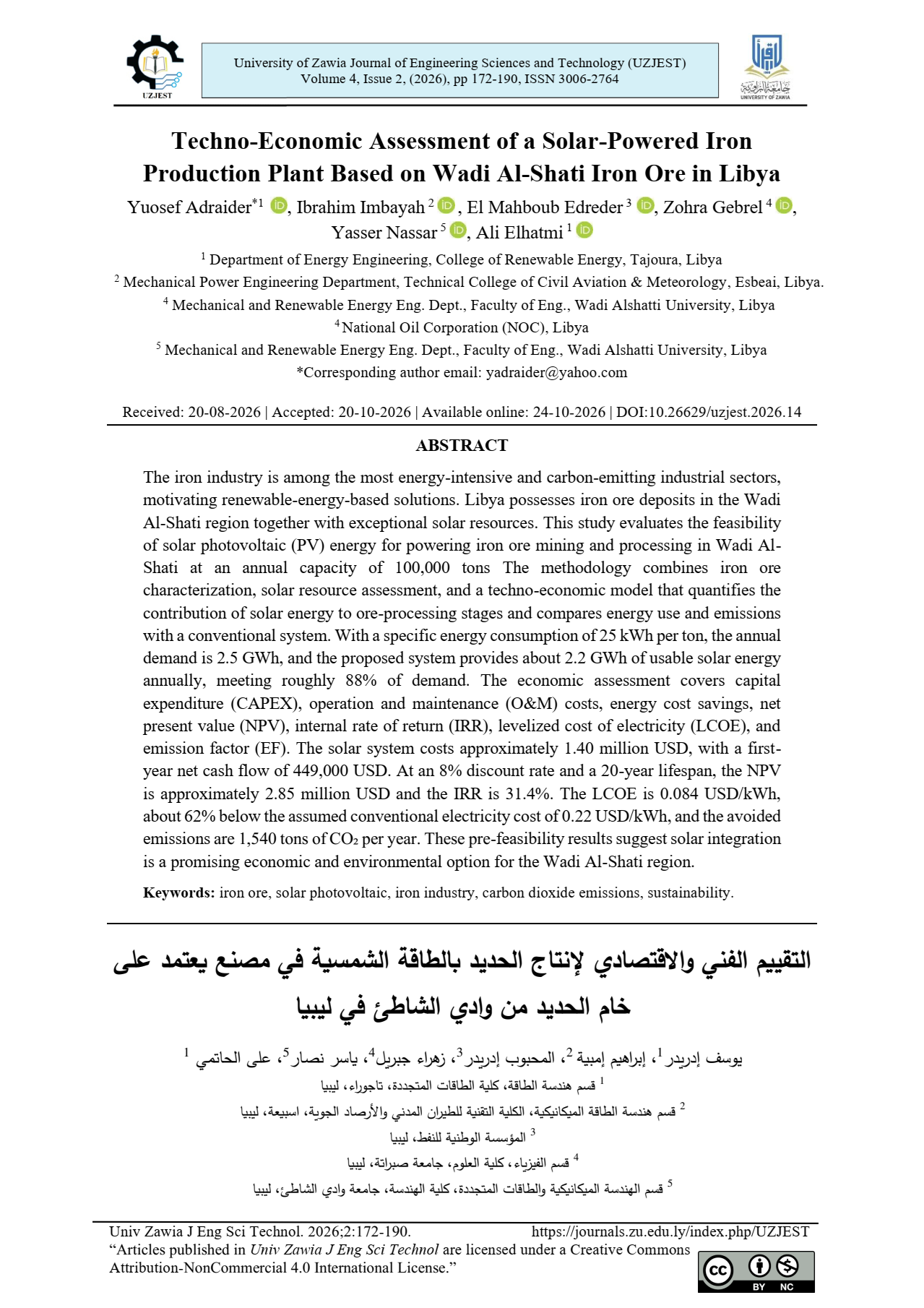
The iron industry is among the most energy-intensive and carbon-emitting industrial sectors, motivating renewable-energy-based solutions. Libya possesses iron ore deposits in the Wadi Al-Shati region together with exceptional solar resources. This study evaluates the feasibility of solar photovoltaic (PV) energy for powering iron ore mining and processing in Wadi Al-Shati at an annual capacity of 100,000 tons The methodology combines iron ore characterization, solar resource assessment, and a techno-economic model that quantifies the contribution of solar energy to ore-processing stages and compares energy use and emissions with a conventional system. With a specific energy consumption of 25 kWh per ton, the annual demand is 2.5 GWh, and the proposed system provides about 2.2 GWh of usable solar energy annually, meeting roughly 88% of demand. The economic assessment covers capital expenditure (CAPEX), operation and maintenance (O&M) costs, energy cost savings, net present value (NPV), internal rate of return (IRR), levelized cost of electricity (LCOE), and emission factor (EF). The solar system costs approximately 1.40 million USD, with a first-year net cash flow of 449,000 USD. At an 8% discount rate and a 20-year lifespan, the NPV is approximately 2.85 million USD and the IRR is 31.4%. The LCOE is 0.084 USD/kWh, about 62% below the assumed conventional electricity cost of 0.22 USD/kWh, and the avoided emissions are 1,540 tons of CO₂ per year. These pre-feasibility results suggest solar integration is a promising economic and environmental option for the Wadi Al-Shati region.
Article Details

This work is licensed under a Creative Commons Attribution-NonCommercial 4.0 International License.