
تعزيز مهارات التواصل الشفهي: استراتيجيات تفاعلية فعالة لطلاب اللغة الإنجليزية كلغة أجنبية في كلية التربية ناصر
DOI:
https://doi.org/10.26629/uzfaj.2026.17الكلمات المفتاحية:
اللغة الإنجليزية، التواصل الشفهي، الاستراتيجيات التفاعلية، الطلاقة في التحدث، تدريس اللغة الإنجليزيةالملخص
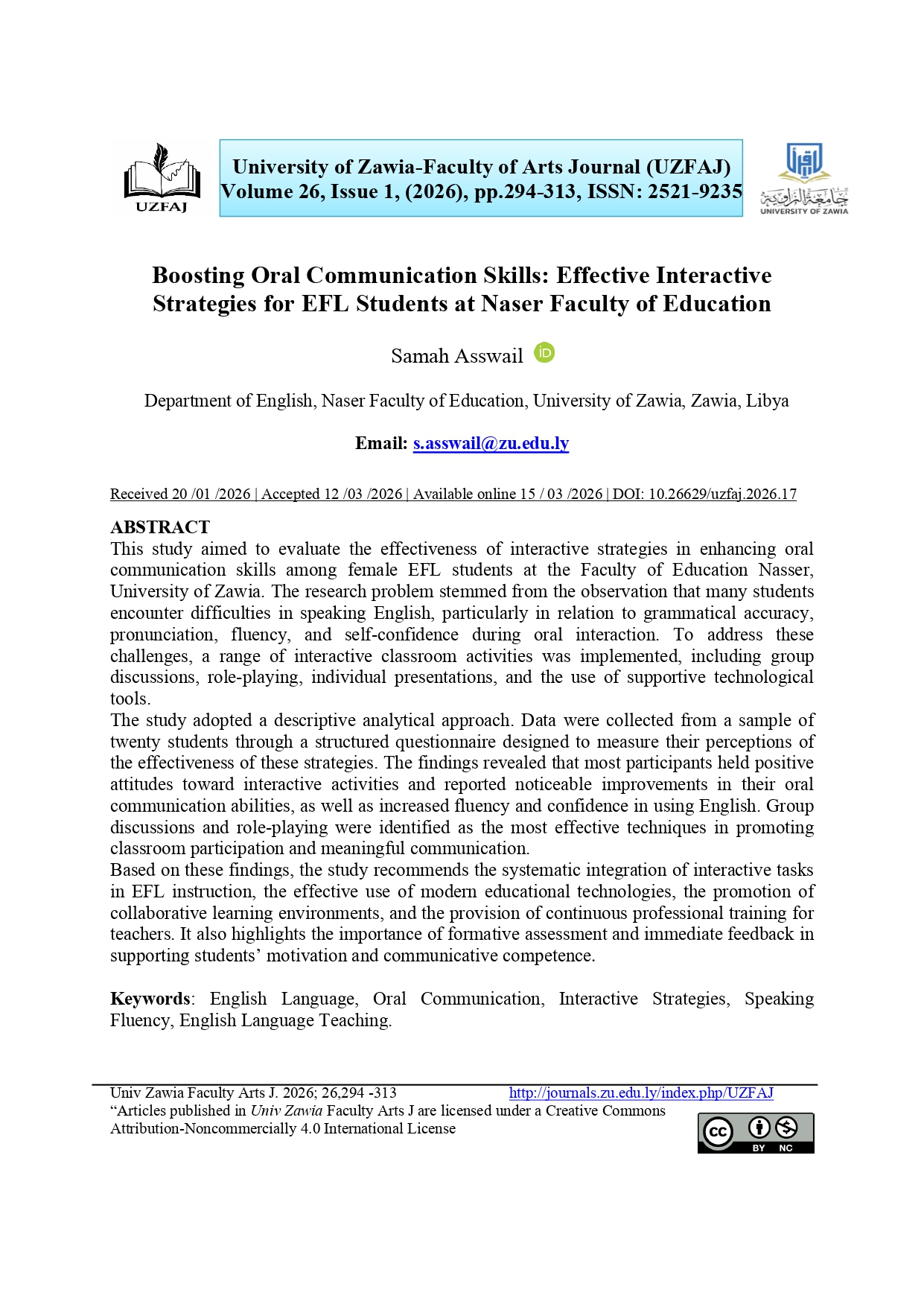
تهدف هذه الدراسة إلى تقويم فاعلية الاستراتيجيات التفاعلية في تنمية مهارات التواصل الشفهي لدى طالبات اللغة الإنجليزية كلغة أجنبية بكلية التربية ناصر في جامعة الزاوية. وتنطلق إشكالية البحث من ملاحظة التحديات التي تواجهها الطالبات في مهارة التحدث، ولا سيما ما يتعلق بإتقان القواعد اللغوية، ودقة النطق، ومستوى الطلاقة، وضعف الثقة بالنفس أثناء التفاعل الشفهي. ولتحقيق أهداف الدراسة، تم توظيف مجموعة من الأنشطة التفاعلية التي شملت المناقشات الجماعية، وتمثيل الأدوار، والعروض التقديمية الفردية، إلى جانب استخدام بعض الوسائل التقنية الداعمة لبيئة التعلم. اعتمدت الدراسة على المنهج الوصفي التحليلي، حيث جُمعت البيانات من عينة مكونة من عشرين طالبة باستخدام استبيان منظم لقياس آرائهن حول فاعلية هذه الاستراتيجيات. وأظهرت النتائج أن غالبية الطالبات أبدين استجابة إيجابية تجاه الأنشطة التفاعلية، مؤكدات دورها في تحسين مهارات التواصل الشفهي وزيادة مستوى الطلاقة والثقة في استخدام اللغة. كما برزت المناقشات الجماعية وتمثيل الأدوار بوصفهما أكثر الأساليب تأثيراً في تعزيز المشاركة والتفاعل داخل الصف. وتوصي الدراسة بضرورة إدماج المهام التفاعلية بصورة منتظمة في تدريس اللغة الإنجليزية، والاستفادة من التقنيات الحديثة، وتعزيز التعلم التعاوني، وتوفير تدريب مهني مستمر للمدرسين، إضافة إلى اعتماد أساليب تقييم بنائي وتغذية راجعة فورية تسهم في دعم دافعية المتعلمين وتنمية كفاءتهم التواصلية.
المراجع
Akdemir, O. (2010). Teaching math online: current practices in Turkey. J. Educ. Technol. Systems 39, 47-64. https://doi.org/10.1007/40279-021-01573.
Alsyouf, A., & Al Kayed, M. (2021). Interactive intervention strategy for english as a foreign language classes versus traditional methods to teach speaking. Studies in English Language and Education, 8(2), p:480.
Al-Magrabi, A. (2023). Technology for speaking skills development. The journal of Faculty of Arts, University of Zawia, 24(2), 30-40.
Al-Mansouri, A. (2023). Enhancing speaking skills through interactive strategies. The journal of Faculty of Arts, University of Zawia, 24(1), 18-25.
An Rongrong, Du Ruoyu& Xu Xin, (2025), Design, Implementation, and Effect of a New Interac-tive Teaching Model for Medical English [J], English Square. (02).
Benguedda,N. (2024). Creating a supportive environment for oral communication. The journal of Faculty of Arts, University of Zawia, 25(1), 15-25.
Bialystok, E. (1990). Communication strategies: Psychological analysis of second language use. New York: Blackwell, p:5.
Braun, V. and Clarke, V. (2006) Using Thematic Analysis in Psychology. Qualitative Research in Psychology, 3, 77-101. https://doi.org/10.1191/1478088706qp063oa
Brown, H. D. (1994). Principles of language learning and teaching (3rd ed.). Prentice Hall.
Cohen, L., Manion, L., & Morrison, K. (2018). Research Methods in Education (8th ed.). London: Routledge. https://doi.org/10.4324/9781315456539
Creswell, J. W. (2014). Research Design: Qualitative, Quantitative and Mixed Methods Approaches. Thousand Oaks, CA: Sage.
Denzin, N., & Lincoln, Y. (2005). Introduction: The discipline and practice of qualitative research.
Derakhshan, A., Khalili, A. N., & Beheshti, F. (2016). Developing EFL Learner's speaking ability, accu-racy and fluency. English Language and Literature Studies, 6(2), 177. https://doi.org/10.5539/ells.
Dörnyei, Z. (2005). The psychology of the language learner: Individual differences in second language acquisition. Lawrence Erlbaum Associates.
Dornyei, Z. (2007) Research Methods in Applied Linguistics, Quantitative, Qualitative and Mixed Methodologies. Oxford University.
Edgcomb, A. D., Vahid, F., Lysecky, R., Knoesen, A., Amirtharajah, R., & Dorf, M. L. (2015). Student performance improvement using interactive textbooks: A three-university cross-semester analysis. In 2015 ASEE Annual Conference & Exposition ,pp:25-26.
Harmer, J. (2001). The practice of English language teaching (3rd ed.). Pearson.
Harmer, J. (2006). The practice of English language teaching (2nd ed.). Longman. P:269.
Khalil, M. (2024). Oral communication skills for EFL learners. The journal of Faculty of Arts, University of Zawia, 25(2), 10-20.
Lu, X., and Ding, Y. (2020). Teaching now, facing the future. Biochem. Mol. Biol. Educ. 48, 568-571. https://doi.org/10.24059/olj.v13i3.1659.
Morrow, K. (2004). Communicative language teaching: A case study. Cambridge University Press.
Ochilovna, K. U., & Sameyevna, M. Z. (2021). Improving speaking skill with the help of modern technologies. Galaxy International Interdisciplinary Research Journal, 9(12), 367-368.
Olowo, B. F., Fashiku, C. O., Adebakin, A. B., & Ajadi, O. T. (2020). Social Media: A Modern Tool to Enhance Communication Skills of the Secondary School Principals in Ekiti State. International Journal of Education and Development using Information and Communication Technology, 16(2), 97-98.
Parveen, B. W. (2016). Use of technology in improving speaking skills. Journal of English language and literature (JOELL), 3(2), 121-122.
Patton, M. (2015) Qualitative Research and Evaluation Methods. 4th Edition, Sage Publications, Thousand Oaks.
Pinto, M., & Leite, C. (2020). Digital Technologies in Support of Students Learning in Higher Education: Literature Review. Digital Education Review, 37, 343-344. https://dialnet.unirioja.es/servlet/articulo?codigo=7615204
Rao, P. S. (2019). The Importance of Speaking Skills in English Classrooms. Alford Council of International English & Literature Journal (ACIELJ), 2(2), 6-9.
Savignon, S. J. (1983). Communicative competence: Theory and classroom competence. Reading, MA: Addison-Wesley,p:130.
Smoyer, A. B., O'Brien, K., & Rodriguez-Keyes, E. (2020). Lessons Learned from COVID-19: Being known in Online Social Work Classrooms. International Social Work, 63(5), 651-654. https://doi.org/10.1177/0020872820940021
Tang, T., Abuhmaid, A. M., Olaimat, M., Oudat, D. M., Aldhaeebi, M., and Bamanger, E. (2020). Efficiency of flipped classroom with online-based teaching under COVID-19. Interact. Learn. Environ. https://doi.org/10.1080/10494820. 2020.1817761.
Wei, T., & Wang, X. (2025). Study on impact of multimedia technology on the quality of English oral teaching based on stepwise regression analysis. International Journal of Continuing Engineering Education and Life Long Learning, 35(1-2), 187-189.
Zein, S. (2016). Pre-service Education for Primary School English Teachers in Indonesia: Policy Implications. Asia Pacific Journal of Education, 36(sup1), 119-120.https://doi.org/10.1080/02188791.2014.961899
Zhang, L. (2020). Rain Classroom-based smart class construction: taking advanced business English courses as an example. Soc. Sci. 9, 98-101.https://doi.org/10.11648/j.ss.20200904.12.
التنزيلات
منشور
كيفية الاقتباس
إصدار
القسم
الرخصة
الحقوق الفكرية (c) 2026 University of Zawia -Faculty of Arts Journal

هذا العمل مرخص بموجب Creative Commons Attribution-NonCommercial 4.0 International License.







 International License.