
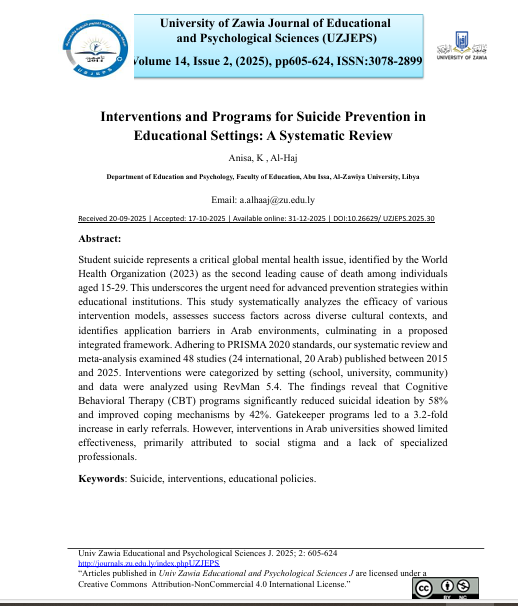
Interventions and Programs for Suicide Prevention in Educational Settings: A Systematic Review
DOI:
https://doi.org/10.26629/uzjeps.2025.30Keywords:
Suicide, interventions, educational policiesAbstract
Student suicide represents a critical global mental health issue, identified by the World Health Organization (2023) as the second leading cause of death among individuals aged 15-29. This underscores the urgent need for advanced prevention strategies within educational institutions. This study systematically analyzes the efficacy of various intervention models, assesses success factors across diverse cultural contexts, and identifies application barriers in Arab environments, culminating in a proposed integrated framework. Adhering to PRISMA 2020 standards, our systematic review and meta-analysis examined 48 studies (24 international, 20 Arab) published between 2015 and 2025. Interventions were categorized by setting (school, university, community) and data were analyzed using RevMan 5.4. The findings reveal that Cognitive Behavioral Therapy (CBT) programs significantly reduced suicidal ideation by 58% and improved coping mechanisms by 42%. Gatekeeper programs led to a 3.2-fold increase in early referrals. However, interventions in Arab universities showed limited effectiveness, primarily attributed to social stigma and a lack of specialized professionals.





 | Articles published in the Univ Zawia J Econ Sci are licensed under a